virtual reality and “ painful procedures ” in geriatrics: findings from the Nice University Hospital trial
Wound dressing, pressure ulcer care, physical therapy sessions: Among 80 patients with an average age of 86, a few minutes of immersion in “ virtual reality ” during treatment reduced reported pain , andanxiety by approximately 45 percent. The caregivers, for their part, found the procedure significantly easier to perform. A look back at a randomized trial conducted at Cimiez Hospital (Nice University Hospital).
Short, repeated, and dreaded treatments
In geriatric care, certain procedures are performed daily or weekly: changing dressings, treating pressure sores and ulcers, helping patients move, and rehabilitation. They can take anywhere from a few minutes for a dressing change to half an hour for a rehabilitation session. But they are painful, and above all, patients know they will be painful.
This anticipation fuels the “anxiety,” which in turn amplifies the “ pain ” felt: a vicious cycle well described in the literature [1]. With each subsequent care interaction, the cycle tightens. The patient becomes anxious, tense, and sometimes resistant, and the caregiver must perform a technical procedure under more difficult conditions.
The vicious cycle of painful treatment: the patient anticipates the pain →anxiety rises → the perceived pain increases → the memory of the treatment reinforces the anticipation of the next one.
Conventional treatments quickly reach their limits in older adults. Pain relievers and anti-anxiety medications are added to what are often lengthy medication regimens, increasing the risk of drug interactions, falls, and confusion; benzodiazepines are, in fact, strongly discouraged for use in older adults [2]. Proven non-pharmacological approaches (cognitive-behavioral therapies, relaxation, meditation) require time, multiple sessions, and intact cognitive function. This is difficult to reconcile with a ten-minute visit in a patient’s room when the patient has neurocognitive impairments.
What is needed, therefore, is a brief, immediate intervention that can be used with or without cognitive disorders and is simple enough to fit into the actual workflow of a department. The “ virtual reality ” checks these boxes on paper. The challenge was to demonstrate its effectiveness under rigorous conditions: Can immersion in virtual reality during a painful procedure truly reduce pain andanxiety in hospitalized elderly patients?
A randomized trial, at the heart of patient care
The study was conducted by Camille Corbel as part of her doctoral dissertation in psychology (LAPCOS and COBTEK laboratories, Université Côte d’Azur) at the Cimiez Hospital of the Nice University Hospital (CHU). It took place in three departments with complementary profiles: post-acute care and rehabilitation, long-term care, and care homes.
Patients. 80 elderly people , with an average age of 86, including 57 women, who were scheduled to undergo recurring painful procedures: dressing changes, treatment of pressure sores or ulcers, or physical therapy sessions. Their average cognitive score (MMSE around 21 out of 30) indicated mild to moderate cognitive disorders in a significant proportion of them: precisely the population for whom conventional approaches are difficult to implement. Only contraindications to the “ virtual reality ” were excluded (significant visual or hearing impairments, unstable epilepsy, acute psychiatric disorders).
Three groups were selected by random draw. The draw was conducted by the University Hospital’s Clinical Research Department. What makes the “ protocol ” unique is its third arm, which allows researchers to test the value of letting patients choose their own treatment group.
- Standard care (40 patients): usual treatment, without virtual reality.
- virtual reality personalized (20 patients): Lumeen immersion in the world the patient has designated as their favorite.
- virtual reality Non-personalized (20 patients): Lumeen immersion in the environment that the patient identified as the least appealing.
The procedure. Before the day of the treatment, patients in the “ virtual reality ” groups tried on the headset and browsed through the virtual environments on a tablet (the ocean, mountains, Animals, cities, etc.) to identify the ones that appealed to them the most and the least. On the day of the treatment, the research psychologist set up the headset and started the immersion experience, after which the treatment proceeded as usual. The entire process, including evaluations, took about 30 minutes.
What was measured. The “ protocol ” deliberately cross-checks what the patient says with what is observed—an essential precaution in geriatrics, where verbal communication may be impaired:
- The Numerical Rating Scale (NRS): The patient self-reports their level of pain and anxiety on a scale from 0 to 10, both before and after treatment. This is the primary outcome measure of the study.
- The Algoplus Scale: During treatment, an observer looks for signs of pain e (facial expressions, eye contact, complaints, body language, behavior) without asking the patient any questions. It is scored on a scale of 5, and a score of 2 or higher indicates probable pain e.
- The Care Delivery Questionnaire: Immediately afterward, the caregiver rates—on a scale of 0 to 10—the difficulty of the procedure, their own fatigue, and the discomfort,anxiety , and pain they observed in the patient.
The trial received approval from an Ethics Review Committee ( Institutional Review Board ,IRB Nord-Ouest I) and was registered prior to its launch (ClinicalTrials.gov NCT05759026).
From the patients' perspective: a nearly 50 percent reduction in both the " pain " and the " anxiety "
Avant le soin, les groupes étaient comparables : même âge, même niveau cognitif, mêmes niveaux de douleur et d’anxiété déclarés. Après le soin, l’écart est net et statistiquement très significatif (p < 0,001), avec des tailles d’effet fortes.
- pain Reported: 4.05 out of 10 with Lumeen, compared to 7.13 with standard treatment—a 43% reduction.
- anxiety Reported: 3.24 out of 10 with Lumeen, compared to 5.92—a 45% reduction.
- pain Observed during the treatment (Algoplus): 1.68 out of 5 with Lumeen, compared to 3.75—a 55% reduction.
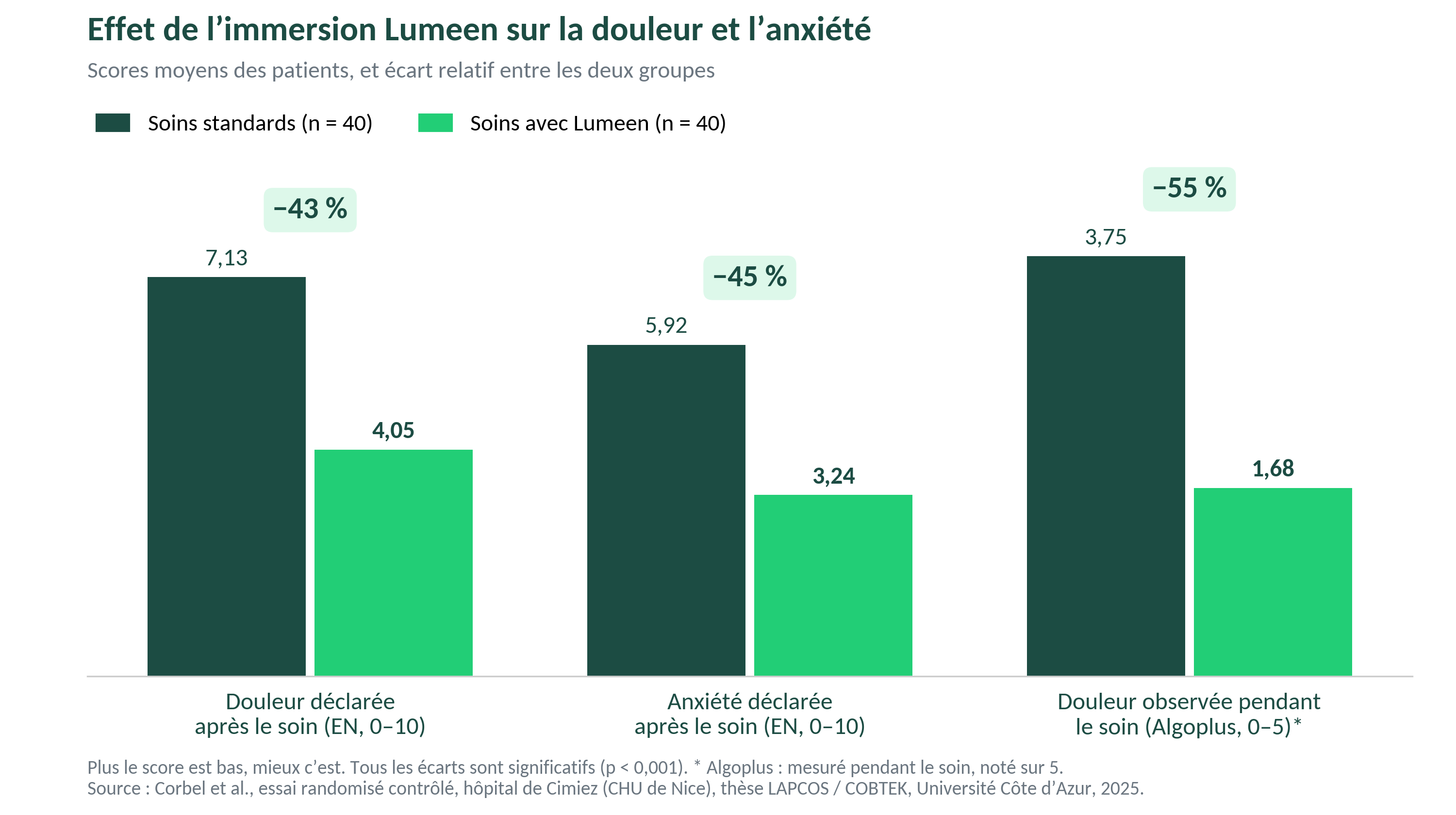
The last outcome is undoubtedly the most meaningful for a caregiver: it is measured at the exact moment the action is performed, through observation, without depending on the patient’s ability to communicate.
One point is worth highlighting. In the group without “ virtual reality,” the “ pain ” reported by patients remained unchanged between the start and end of treatment (7.33 and then 7.13), and the reported “anxiety ” decreased only slightly (6.74 and then 5.92). With Lumeen, over the same period, the reported “ pain ” decreased from 6.71 to 4.05, and the “anxiety ” from 5.87 to 3.24. The relief observed with Lumeen cannot therefore be explained simply by the relief of seeing the treatment come to an end.
Finally, the effect was comparable regardless of the type of treatment: bandage, pressure sore, ulcer, or rehabilitation.
The choice of treatment population does not affect the clinical outcome
The study compared the patient’s preferred setting with the one they found least appealing. The result: relief was the same in both cases. The hypothesis that personalization provides an additional benefit was not confirmed.
This is good news for the teams. The effect seems to stem primarily from the immersion itself—that break from the hospital room, the bandages, and the medical procedures—rather than from the theme of the content offered. It’s still important to note that all Lumeen worlds are designed to be soothing, which may explain why none performs worse than the others. In practical terms, a team can start a session without worrying about making a mistake, even on a tight schedule. Letting the patient choose their own world remains valuable: it’s a moment of enjoyment, a topic for conversation, and a way to give them back an active role. It’s simply not a prerequisite for effectiveness.
caregivers : A move that's easier to perform
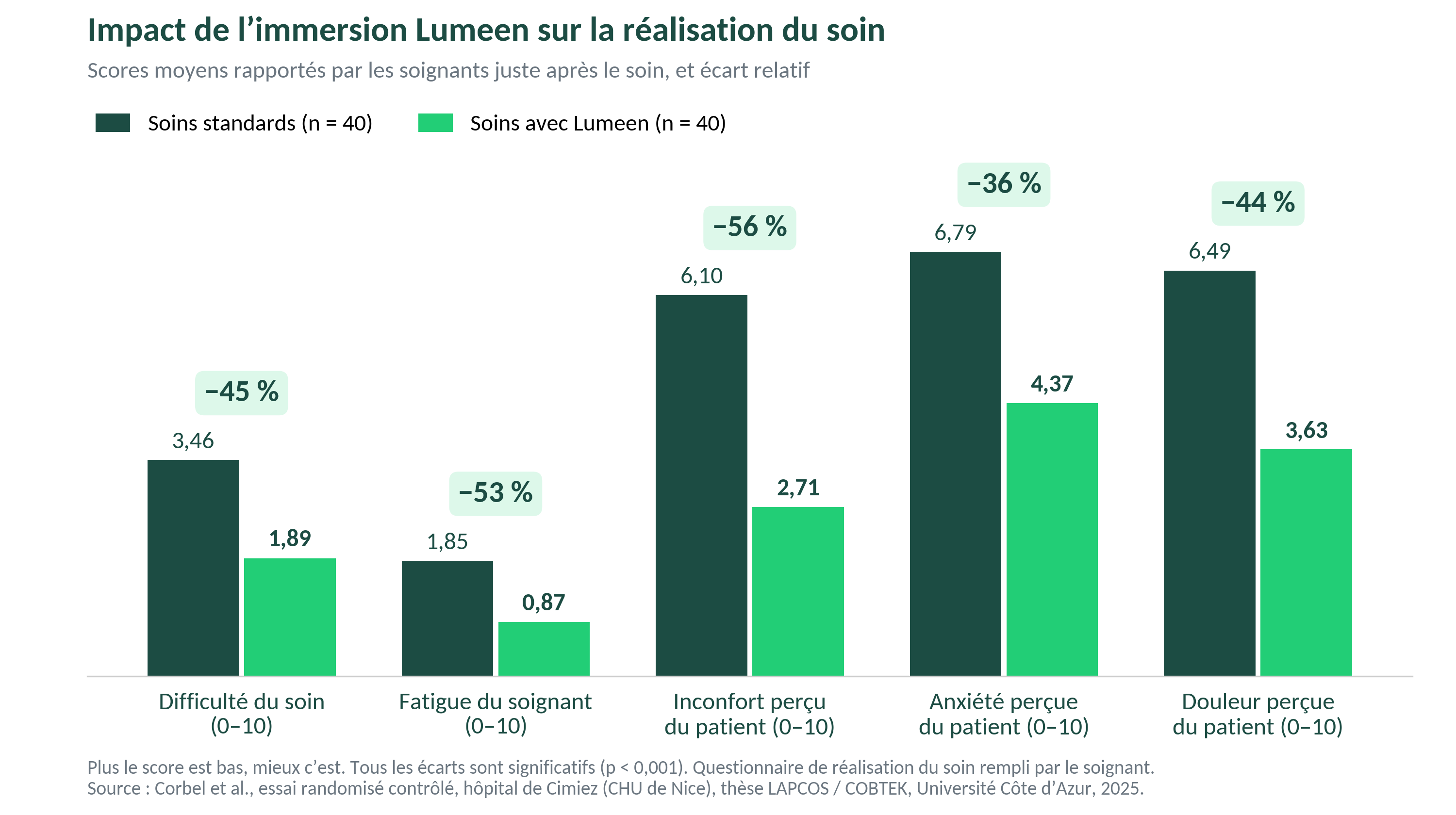
Le bénéfice ne s’arrête pas au patient. Juste après chaque soin, le soignant qui l’avait réalisé remplissait un court questionnaire, noté de 0 à 10. Tous les écarts entre les deux groupes sont significatifs (p < 0,001).
- Treatment difficulty: 1.89 with Lumeen, compared to 3.46 with standard treatments—a 45% reduction. This is the most tangible result for a team: a relaxed patient tenses up less, and the procedure goes more smoothly.
- Perceived discomfort in patients: 2.71 versus 6.10, a 56% reduction.
- pain and the patient's perceived " anxiety ": 3.63 versus 6.49 and 4.37 versus 6.79, respectively.
- Caregiver fatigue: 0.87 versus 1.85. The difference is real, but fatigue related to a single care episode remained low in both groups.
A tool that was well received by the teams. Twenty-five hospital professionals evaluated the tool using a standard usability scale (System Usability Scale). Important note: During the trial, the “ psychologist ” operated the headset. These professionals therefore assessed the tool by observing it in action during their patient care, rather than by operating the sessions themselves. The average score was 78.5 out of 100, a level considered good to excellent. Ease of learning and confidence in use received the highest ratings (4.3 out of 5), while perceived complexity (1.8 out of 5) and the need for technical assistance (1.6 out of 5) remained very low.
Integrating " virtual reality " into a Department: Key Points from the Dissertation
Based on her research, the author offers concrete recommendations for integrating the “ virtual reality ” into geriatric care:
- Who it is for: Patients aged 60 and older, with or without mild to moderate cognitive disorders . The benefit appears to be less pronounced in cases of severe cognitive impairment (MMSE score of approximately 10 or lower). Caution is advised in patients with a history of epilepsy or psychotic disorders, and immersion is of limited use in cases of significant visual or hearing impairment.
- Before: Introduce the headset to the patient and have them try it on during an initial consultation, so they can get to know the device outside of a treatment setting.
- Duration: A 20- to 30-minute session is well tolerated and corresponds to the duration of most treatments. The caregiver remains present, talks to the patient, ensures the patient’s physical safety, and the patient can stop at any time.
- When the patient's position does not allow for it: immersion can take place just before or just after the treatment. In physical therapy, it works well when the patient is sitting or lying down.
- Within the organization: designate one or more trained staff members in the department to serve as points of contact, and establish a h protocol for disinfecting the helmet between patients.
Limitations, and What Comes Next
Like any study, this one has its limitations, and it is helpful to be aware of them in order to interpret the results accurately.
- A single site. The trial was conducted at a single hospital. Studies at other institutions are needed to confirm that the results hold true elsewhere.
- Blindness was not possible. A patient wearing a headset is visible: neither the patient, nor the researcher, nor the caregiver could have been unaware of who was receiving the in virtual reality. The observed measures (Algoplus, caregiver questionnaire) may therefore have been influenced by this knowledge. This is a limitation inherent to this type of intervention.
- A dedicated person. In the trial, the headset was set up and operated by the study’ psychologist , while the caregivers focused on the task at hand. It remains to be seen whether the benefits are maintained when the team manages the session on its own.
- A single session. The effect was measured during and immediately after a treatment. It is not yet known whether the effect persists or increases with repeated treatments.
- A publication in progress. The results are drawn from a doctoral dissertation defended in June 2025; the scientific article is being prepared for submission to a peer-reviewed journal.
There are several possible paths forward:
- multicenter studies involving larger sample sizes;
- the evaluation of repeated immersions over a period of several weeks protocol : anticipatoryanxiety s develop over time; the same may be true for soothing;
- the inclusion of objective physiological markers, such as heart rate [3];
- evaluation under real-world conditions, when the " caregivers " themselves provide the headset and lead the session during treatment;
- the impact on the “ care pathways ” itself: treatment time, use of pain relievers [4].
Key Takeaways
In patients with an average age of 86, many of whom have cognitive disorders, a few minutes of Lumeen immersion during a painful procedure reduces their reported pain andanxiety by approximately 45 percent, and reduces the pain observed during the procedure by more than half. From the staff’s perspective, the procedure is considered nearly half as difficult to perform, and professionals who have seen the device in action find it simple and well-suited to their practice.
As a non-pharmacological approach that can be used with patients with cognitive disorders, virtual reality is establishing itself as a credible complementary treatment in geriatric care settings.
Transparency and Acknowledgments
This study was designed, conducted, and analyzed by the research team at LAPCOS and COBTEK (Université Côte d’Azur), under the auspices of the Nice University Hospital. It was funded by the Ministry of Higher Education and Research (doctoral contract) and by the National Research Agency for equipment. Lumeen is neither an author nor a funder of this study, and the authors declare no conflicts of interest.
We would like to extend our heartfelt thanks to Camille Corbel, Xavier Corveleyn, and Jean Breaud; Dr. Françoise Capriz; Prof. Olivier Guérin; and the entire staff at Cimiez Hospital and the Nice University Hospital, as well as all the patients and caregivers who made this research possible.
References
- Elman, I., & Borsook, D. (2018). Threat Response System: Parallel Brain Processes in Pain versus Fear and Anxiety. Frontiers in Psychiatry, 9, 29.
- Wang, P. S., Bohn, R. L., Glynn, R. J., Mogun, H., & Avorn, J. (2001). Hazardous Benzodiazepine Regimens in the Elderly: Effects of Half-Life, Dosage, and Duration on the Risk of Hip Fracture. American Journal of Psychiatry, 158(6), 892–898.
- Halbig, A., & Latoschik, M. E. (2021). A Systematic Review of Physiological Measurements, Factors, Methods, and Applications in Virtual Reality. Frontiers in Virtual Reality, 2.
- Delshad, S. D., Almario, C. V., Fuller, G., Luong, D., & Spiegel, B. M. R. (2018). Economic analysis of implementing virtual reality therapy for pain among hospitalized patients. npj Digital Medicine, 1(1), 22.
Source study: Virtual Reality for Pain and Anxiety Management During Painful Procedures in Hospitalized Older Patients: A Randomized Controlled Trial. Camille Corbel, Flora Le Cerf, Françoise Capriz, Anne-Julie Vaillant-Ciszewicz, Jean Breaud, Olivier Guérin, Xavier Corveleyn
Want to test Lumeen for 30 days with no commitment ?