virtual reality Disabilities: What Are the Results After Two Years of Testing?
.avif)
Since its founding in 2018, Lumeen has consistently observed the social and therapeutic benefits that virtual reality brings virtual reality elderly people. As a result, a growing number of care facilities and healthcare professionals have entrusted us with helping their residents improve their daily well-being. It was through these experiences that the idea quickly took root to test our virtual reality solution virtual reality the disability sector.
Indeed, the potential for integrating virtual reality this field—particularly for therapeutic purposes—is considerable; in fact, it has been explored in France and around the world for several years. The Auvergne-Rhône-Alpes Region has fully recognized this and has enabled us to bring this initiative to life by providing financial support for the project, starting in March 2020, for a two-year pilot program.
A strong professional and personal partnership
And it is alongside recognized partners on the ground, such as the Jean-Marie Arnion Center for Motor Education (CEM) in Dommartin, that we have embarked on this new human adventure.
The CEM in Dommartin is part of the Odynéo network, an organization active in three departments (Rhône, Ain, and Jura) that serves people with disabilities their families. It welcomes children and adolescents aged 11 to 20 with neuromotor disabilities and supports them throughout their lives. Through an individualized pedagogical, educational, and therapeutic program, the CEM provides tailored care for each resident and supports them in their development and socialization, as well as in learning to communicate, while offering appropriate paramedical and medical care.
virtual reality workshops
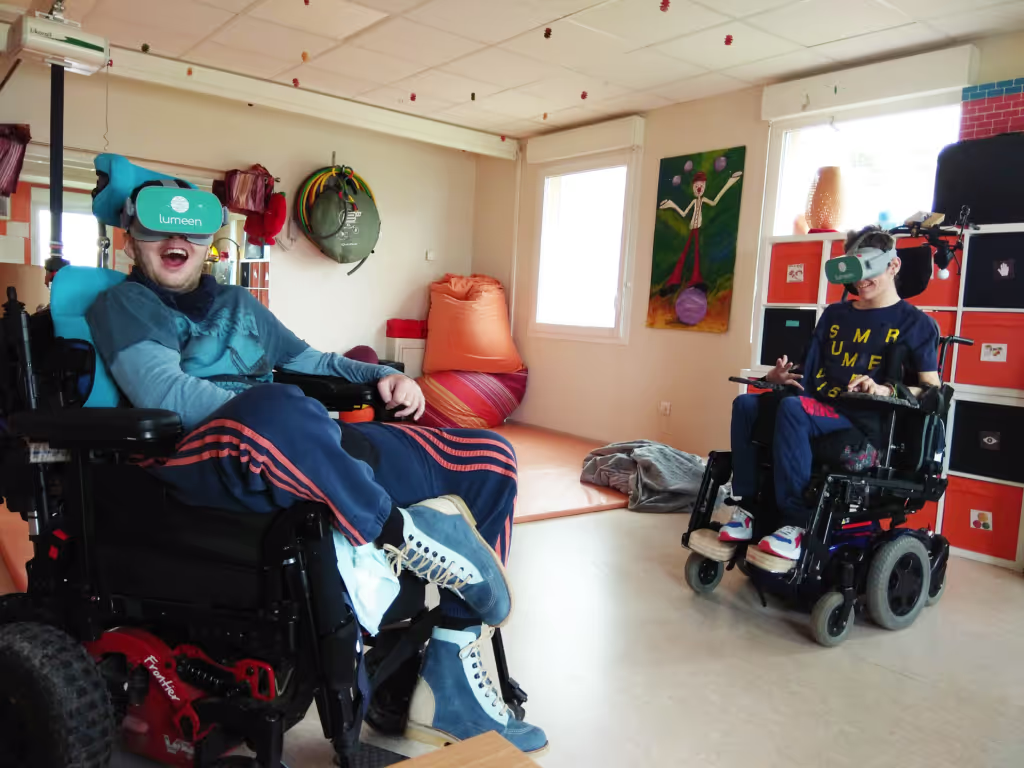
Lumeen was then added to the range of tools used by the center’s teams. virtual reality Headsets are used virtual reality to facilitate group workshops that incorporate educational and pedagogical elements, non-pharmacological therapy, as well as more playful and recreational aspects.
Within the teams, occupational therapists and psychomotor therapist use this approach most frequently, along with educators. Most often, the workshops consist of one professional—who is responsible for preparing and structuring the activity—and two to three young people, whom the professional guides from the beginning to the end of the session.
Two specific modules are used regularly:
- First, the “ getaway ” module, which offers immersive experiences: users can swim with dolphins or gaze at the Northern Lights. Accompanied by educational content—that is, an introductory presentation and a review quiz tailored to the target audience—these experiences are designed to encourage interaction and discussion;
- The reminiscence module, meanwhile, uses Google Street View to transport users to a specific location. This allows them to explore a place they are familiar with, prepare for a future visit—and thereby prevent or at least alleviate anyanxiety they might feelanxiety the unfamiliar—or simply discover new places through the virtual reality headset.
Real benefits observed by healthcare professionals
At the end of the first year of use, we spoke with Dr. Simonnot (co-founder of Handicap International and medical coordinator for the Odynéo network), who drew the following conclusion:
“The results obtained—noted primarily by professionals who use the program for its intended purpose—are generally positive. For some young people, the results are remarkable, with a genuine calming effect, particularly for those with brain injuries and severe behavioral disorders. The young people are calm, composed, and open to interaction and discussion.”
This was already a promising assessment, and we are proud to have reinforced it, as many positive aspects of Lumeen have since been identified following two years of testing.
Use for therapeutic purposes
The CEM serves young people, many of whom have significant cognitive disorders behavioral cognitive disorders , as well as limited access to sensory experiences. As a result, the range of educational resources that can be used is constrained and limited.
By offering a new and immersive experience—sometimes surprising, often captivating—the use of virtual reality headsets virtual reality proven virtual reality a key tool for improving attention and concentration. The professionals interviewed highlighted the device’s ability to “bring [residents] into the present moment.” Furthermore, Lumeen sometimes makescaregivers easier forcaregivers pairscaregivers connect, for example by prompting comments or interaction about the situation they are currently experiencing.
Virtual reality headsets are also described as a “mediation” tool that can help achieve other therapeutic goals. First, on an ad hoc basis: by redirecting the user’s attention, virtual reality experiences can facilitate muscle relaxation and promote relaxation of the body and mind. Then, in the long term: young people gradually build up a repertoire of positive mental images associated with specific emotions. The goal is to help them embrace a sensation or emotion, understand what they are experiencing and how it manifests in their bodies, so they can reproduce it later. This repertoire of images becomes a new tool, with the idea of being able to draw on it later during other situations in daily life—for example, to combatanxiety pain medical procedures.
A mechanism that enhances body awareness
virtual reality also emerged as a valuable tool for learning about the body and sensations. First, hearing and sight are the two senses primarily engaged by these immersive experiences. By exposing the young people at the center to situations that are sometimes inaccessible in their daily lives, these experiences can, on their own, generate entirely new sensations and emotions.
This activity is often supplemented by the supervising professionals using various sensory materials. These materials can be tactile (by introducing different textures—such as beach sand—and different materials, or through “thermal” experiences—using warm or cold materials, depending on the proposed immersion) or olfactory (by incorporating characteristic scents—such as lavender for a trip to Provence). The goal is to transcend physical limitations and help residents discover new sensations and forms of stimulation.
An educational tool
Finally, Lumeen has established itself as a valuable tool for engaging participants. First and foremost, it gives people with disabilities opportunity to experience “a special time” and to feel “just like everyone else.” As one of the CEM’s educators put it: “With virtual reality …] the young people see the same thing I do. […] It’s something they can do just as well as I can.” They then experience situations and emotions that are unique to them.
What’s more, by inviting users to explore a theme, a place, or a landscape, virtual reality headsets virtual reality a unique experience that promotes learning. Here, too, professionals can enhance these immersive tools with music, sensory experiences, or supplementary knowledge, thereby offering sessions with an educational component for young people who are not always enrolled in school.
An solution tailored to educational institutions
Of course, during these two years of testing, the project was not without its challenges. people with disabilities specific needs, and for some, the device is not always easy to use. For example, the weight of the headset posed a real challenge, sometimes requiring human assistance to support it.
Dedicated to offering a solution that is ever more tailored to our diverse audiences, we have decided to introduce a new headset model to address this issue. Thanks to its improved weight distribution, this new headset allows even more people to enjoy our solution in the best possible way.
At the end of these first twenty-four months, the solution offered by Lumeen has undeniably been used very frequently by CEM professionals. These results would not have been possible without the trust placed in us by all of our partners.
We would like to take this opportunity to sincerely thank Dr. Simonnot for his dedication, as well as all the CEM teams for their commitment and their testimonials. And since the CEM has expressed a desire to make this tool a permanent part of its operations, it is with joy and pride that Lumeen officially renewed its partnership with the center in 2022.
We would also like to thank the Auvergne-Rhône-Alpes Region for its support, and especially Sandrine Chaix, special advisor on disability issues. We are proud to be helping to build the disability-friendly, disability-supportive, and disability-inclusive society of tomorrow.
Building on these developments, we reaffirm today our interest and our commitment to contributing even more to advancing research on the benefits of virtual reality the disability sector, as well as to its implementation. Lumeen will continue its commitment and commercial development in this direction. We look forward to continuing this wonderful adventure alongside you!
Want to test Lumeen for 30 days with no commitment ?