
virtual reality a Non-Pharmacological Intervention (NPI)
%25201.avif)
Background and Challenges of Nonpharmacological Interventions (NPI)
medication sparing—or the judicious use of medications—has become a major challenge for modern healthcare systems. From a public health perspective, reducing medication use helps minimize side effects and the risk of complications related to drug interactions. From an economic standpoint, this approach helps reduce costs associated with medications and their storage. In certain care pathways, medication sparing faster patient recovery, freeing up beds more quickly to improve service performance. Furthermore, medication sparing environmental concerns by reducing the ecological footprint associated not only with pharmaceutical products themselves but also with their production and the management of the waste they generate.
In order to limit the excessive use of medications, an increasing number of learned societies and public interest organizations—such as the NPIS (Non-Pharmacological Intervention Society), the SFAR (French Society of Anesthesia and Intensive Care), and the Médéric Alzheimer Foundation—are focusing on the development of non-pharmacological interventions (NPI) [1] [2]. Furthermore, the Médéric Alzheimer Foundation recently incorporated virtual reality its Guide to NPI Alzheimer’s Disease, published in 2024 [1].
In this article, we will explore how the integration of virtual reality a non-pharmacological intervention can contribute to medication sparing various clinical settings. We will draw on several real-world examples to illustrate the impact of this new technology.
virtual reality a Non-Pharmacological Intervention: Real-World Clinical Cases
In the operating room
Before surgery, the use of virtual reality can reduce apatient’s levelanxiety [3], [4], [5]. A study conducted on 40 patients scheduled for rhinoplasty demonstrated that virtual reality a significant reduction inanxiety [3]. A case study of a patient scheduled Surgery revealed a 67% reduction inanxiety levels thanks to virtual reality 4]. Less anxious patients are more likely to follow the surgeon’s instructions, which facilitates smoother procedures and reduces operating time. This will also help limit the use of anxiolytics (before surgery) and pain relievers (after surgery) and avoid the risks associated with these medications. All of this contributes to better surgical outcomes and improved postoperative recovery, thereby helping to reduce overall healthcare costs.
virtual reality is also useful during surgery. A literature review shown that in various clinical settings (venipuncture, Dental care, colonoscopy, burn care, nasal endoscopy, etc.), virtual reality with local anesthesia can reduce the need for sedation avoid the use of general anesthesia [ 6]. This pain management method, recommended by the SFAR, helps reduce the consumption of anesthetic gases [7], [8]. These gases, which are pollutants and harmful to health, are poorly metabolized by the human body and are therefore largely released into the atmosphere [9], [10], [11]. By limiting the use of anesthetic gases in the operating room, virtual reality reduce their negative impact on the environment and protects the health of caregivers.
During treatment
As we saw in a previous article, virtual reality is effective at reducing pain , particularly in cases involving wound and burn care and needle and catheter insertions. This will have a positive impact on the use of pain medication (opioids). In fact, studies conducted in the context of burn care [12] and among women with breast cancer [13] have shown that, when used as a supplement to standard pharmacological treatments, virtual reality a reduction in the use of strong opioids (up to a 40% reduction in [12]). The misuse of strong opioids constitutes a public health and economic problem, as it can lead to patient dependence , affecting their quality of life and requiring additional long-term care, which represents a cost to the healthcare system [14]. The use of non-pharmacological interventions, such as virtual reality, as soon as the first signs of pain appear, will have a positive impact on the use of these opioids and on the associated costs. By reducing the risk of dependence, this technology helps limit the costs associated with long-term care for dependent individuals.
In medical and social care facilities
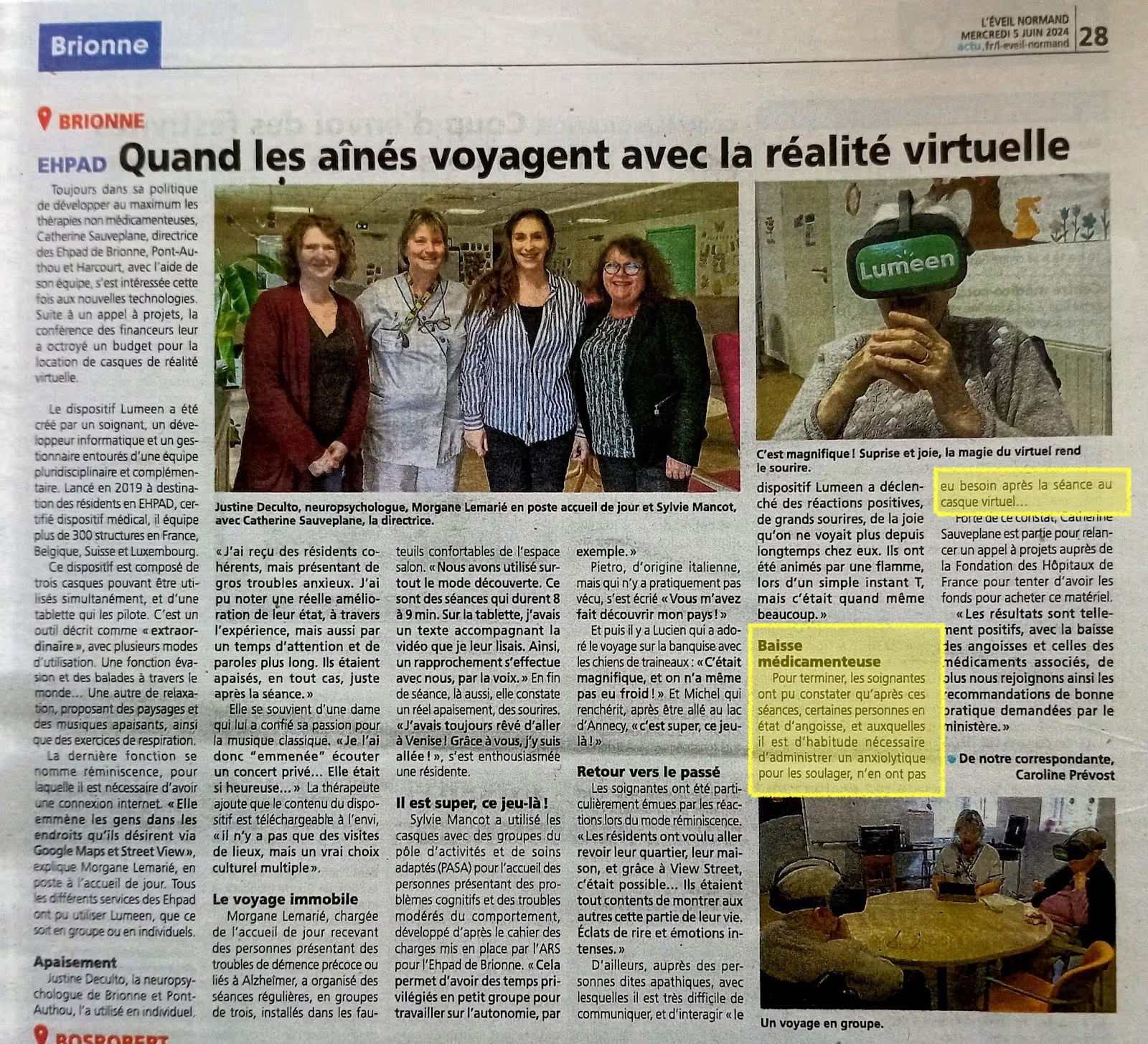
Beyond the Healthcare sector, virtual reality also virtual reality beneficial in long-term care facilities that serve elderly people or people with disabilities. Many caregivers Lumeen in the field have observed a decrease in the use of anxiolytics and pain relievers among elderly residents, particularly during painful procedures pressure ulcer dressing changes (as shown in a caregiver’s testimonial published in “L’Éveil Normand,” Figure 1). Reducinganxiety pain care reduces the need for pharmacological treatments, which in turn limits the undesirable side effects of these medications, which are often significant in elderly people frail elderly people .
Excerpt from the article: " caregivers after these sessions, some people experiencing anxiety—who usually require an anti-anxiety medication for relief—did not need it after the virtual reality headset session."
virtual reality also be used to reduce mood disorders, including apathy. Indeed, although studies are still few in number, they show encouraging results regarding the use of this technology in the management of behavioral and psychological symptoms of dementia, notably including a decrease in apathy scores during virtual reality sessions virtual reality 15], [16]. Apathy can lead to increased use of medications, such as antidepressants, anxiolytics, and hypnotics, because clinicians may mistake it for depression oranxiety. By stimulating patient engagement and interest, virtual reality have a positive and significant impact on medication sparing, thereby helping to improve patients’ overall well-being and quality of life.
The key takeaway
By promoting the development of non-pharmacological interventions such as virtual reality adopting a more responsible and sustainable approach to medication use, we can improve the quality of care, save money, and help protect the environment.
Lumeen is committed to promoting medication sparing supporting the healthcare system. Recently, Corentin Metgy, co-founder and president, spoke on this topic at the annual forum of the Agence du Bon Usage du Médicament (ABUM). You can find his remarks below:
Further Reading
- https://www.leem.org/media/les-impacts-environnementaux-des-medicaments
- https://www.entreprises.gouv.fr/fr/consultation-publique-evaluation-de-l-empreinte-carbone-des-medicaments
- https://www.has-sante.fr/jcms/p_3475967/fr/la-has-adopte-une-feuille-de-route-sante-environnement
- https://sfar.org/
References
[1] Y. Mederic Alzheimer Foundation, “Non-Pharmacological Interventions and Alzheimer’s Disease,” 2024. Accessed June 7, 2024. [Online]. Available at:NPI
[2] N. Stoicea, A. Costa, L. Periel, A. Uribe, T. Weaver, and S. D. Bergese, “Current perspectives on the opioid crisis in the U.S. healthcare system: A comprehensive literature review,” Medicine (Baltimore), vol. 98,no. 20, p. e15425, May 2019, doi: 10.1097/MD.0000000000015425.
[3] A. D. Baytar and K. Bollucuoglu, “Effect of virtual reality on preoperative anxiety in patients undergoing septorhinoplasty,” Braz. J. Anesthesiol. Engl. Ed., vol. 73,no. 2, pp. 159–164, March 2023, doi: 10.1016/j.bjane.2021.08.014.
[4] A. Flores et al., “Using Immersive Virtual Reality Distraction Reduce Fear and Anxiety before Surgery,” Healthcare, vol. 11,no. 19, p. 2697, Oct. 2023, doi: 10.3390/healthcare11192697.
[5] L. Ganry, B. Hersant, M. Sidahmed-Mezi, G. Dhonneur, and J. P. Meningaud, “Using virtual reality to control preoperative anxiety in ambulatory surgery patients: A pilot study in maxillofacial and plastic surgery,” J. Stomatol. Oral Maxillofac. Surg., vol. 119,no. 4, pp. 257–261, Sept. 2018, doi: 10.1016/j.jormas.2017.12.010.
[6] R. Hitching et al., “The Emerging Role of Virtual Reality as an Adjunct to Procedural Sedation and Anesthesia: A Narrative Review,” J. Clin. Med., vol. 12,no. 3, p. 843, Jan. 2023, doi: 10.3390/jcm12030843.
[7] L. Bonnet, J. Muret, and J.-C. Pauchard, “Reducing Pollution from Inhaled Anesthetic Gases.”
[8] E. M. Hafiani, J.-C. Pauchard, J. Muret, M. Bruyere, and L. Bonnet, “Reducing/Eliminating the Use of Nitrous Oxide.”
[9] M. K. Vollmer et al., “Modern inhalation anesthetics: Potent greenhouse gases in the global atmosphere,” Geophys. Res. Lett., vol. 42,no. 5, pp. 1606–1611, March 2015, doi: 10.1002/2014GL062785.
[10] J. F. Boivin, “Risk of spontaneous abortion in women occupationally exposed to anesthetic gases: a meta-analysis,” Occup. Environ. Med., vol. 54,no. 8, pp. 541–548, August 1997, doi: 10.1136/oem.54.8.541.
[11] K. Teschke et al., “Exposure to Anesthetic Gases and Congenital Anomalies in the Offspring of Female Registered Nurses,” Am. J. Ind. Med., vol. 54,no. 2, pp. 118–127, Feb. 2011, doi: 10.1002/ajim.20875.
[12] T. McSherry, M. Atterbury, S. Gartner, E. Helmold, D. M. Searles, and C. Schulman, “Randomized, Crossover Study of Immersive Virtual Reality to Decrease Opioid Use During Painful Wound Care Procedures in Adults,” J. Burn Care Res., p. 1, May 2017, doi: 10.1097/BCR.0000000000000589.
[13] M. Ahmad, E. Bani Mohammad, E. Tayyem, E. Al Gamal, and M. Atout, “Pain and Anxiety in Patients with Breast Cancer Treated with Morphine versus Tramal with Virtual Reality,” Health Care Women Int., vol. 45,no. 7, pp. 782–795, July 2024, doi: 10.1080/07399332.2023.2257627.
[14] A. M. Dydyk, N. K. Jain, and M. Gupta, “Opioid Use Disorder,” in StatPearls, Treasure Island (FL): StatPearls Publishing, 2024. Accessed June 5, 2024. [Online]. Available at: http://www.ncbi.nlm.nih.gov/books/NBK553166/
[15] R. E. Brimelow, B. Dawe, and N. Dissanayaka, “Preliminary Research: Virtual Reality in Residential Aged Care to Reduce Apathy and Improve Mood,” *Cyberpsychology, Behavior, and Social Networking*, vol. 23,no. 3, pp. 165–170, March 2020, doi: 10.1089/cyber.2019.0286.
[16] D. Saredakis, H. A. Keage, M. Corlis, and T. Loetscher, “Using Virtual Reality to Improve Apathy in Residential Aged Care: A Mixed-Methods Study,” J. Med. Internet Res., vol. 22,no. 6, p. e17632, June 2020, doi: 10.2196/17632.
Photo credit: Coline Bachelier
Want to test Lumeen for 30 days with no commitment? ?


.jpg)