
A Study on virtual reality Tolerance virtual reality care homes
.avif)
One of Lumeen’s goals is to develop scientific collaborations to evaluate the benefits of our virtual reality solution . Today, we are pleased to present the results of the RAVI study: “Tolerance of virtual reality Use virtual reality Residents ofcare homes for elderly people .” This study was conducted as part of a doctoral thesis at the Institute of Sport Sciences at Université Paris Cité, in partnership with Gérond’if (the Île-de-France Gerontology Center) and Lumeen. It focuses on tolerance (the subject’s ability to endure the immersive experience psychologically and physiologically) and acceptance (the subject’s implicit or explicit consent to wear the device) of virtual reality a headset among elderly people in care homes.
Tolerance, Acceptance, and Cyberkinetosis
virtual reality headsets (also known Headsets virtual reality Headsets ), such as those included in the solution , isolate the user from their surroundings by stimulating two of their senses (sight and hearing) to give them a sensation in virtual reality. However, using a headset can sometimes cause cyberkinetosis during or after immersion, which can be a barrier to the use of thistechnology.¹ Before presenting the results of this new study, let’s start by defining what cyberkinetosis is.
What is cyberkinetosis?
This is a common side effect of virtual reality, which has threecomponents2:
- The first symptom is a sensation , or even nausea, similar to what one might experience when suffering from motion sickness. This is caused by a sensory conflict between our vision and the vestibular system in our inner ear (which is responsible for maintaining balance). This occurs in particular when the movements we see through the headset do not match what our inner ear perceives (i.e., a lack of movement)3.
- The second factor is eye strain. It is caused by significant and rapid changes in light levels inside the headset.
- The third component is disorientation resulting from the disconnect between the real world and the virtual world.
In France, 30 to 50% of virtual reality users virtual reality cyberkinetosis.⁴ In most cases, these symptoms are mild and subside after a few minutes. However, some people may be more susceptible to cyberkinetosis (particularly if they are prone to motion sickness), which can negatively affect their virtual reality experience.anxiety to the onset of these symptoms can also affect tolerance of the headset. It is therefore important for developers like Lumeen, who create solutions intended for use by vulnerable populations—such as elderly people in care homes—to minimize the risk of cyberkinetosis.
Cyberkinetosis is more common in experiences that involve rapid movements and/or sudden changes in perspective. Furthermore, regarding the duration of these experiences, it appears that the longer they are,the higher the risk of cyberkinetosis2. The Lumeen team works to minimize the risk of cyberkinetosis by designing immersive experiences tailored to vulnerable audiences: short (between 7 and 12 minutes), calm, soothing, and featuring controlled camera movements. Every shot included in the immersive experiences in our catalog is approved by our team of experts, in accordance with strict specifications, to ensure a safe and high-quality user experience.
That said, there is currently little data on cyberkinetosis amongcare homes residents. The RAVI study was therefore launched to learn more about the potential negative effects of virtual reality this population by evaluating, in collaboration with a recognized and impartial partner, the acceptance and tolerance of our device among elderly people care homes mean age = 89 years).
Tolerance and Acceptance of virtual reality care homes Residentscare homes Results of the RAVI Study
The results of this clinical study were recently published in a well-known scientific journal. We have summarized them for you below.
The primary objective of the study was to assess the tolerability of the VR headset and the Lumeen experiences among elderly people in care homes measuring cyberkinetosis after each session. In addition, the secondary objective was to evaluate the acceptance of the device and the virtual reality scenes virtual reality by Lumeen, as well as their effect onanxiety .
Participant recruitment took place from July 2021 to January 2022 in eight care homes the care homes region*. For each participant, the evaluation period lasted one week, during which they were exposed three times to virtual reality scenes virtual reality by Lumeen. These three immersive experiences (360° videos) from our catalog were presented in random order (Figure 1).

Figure 1. Visualization of the three Lumeen immersive experiences offered to participants.
Tolerance to virtual reality assessed using the Simulator Sickness Questionnaire (SSQ). Originally developed to evaluate adverse effects in flight simulators, the use of this questionnaire has expanded with the rise of virtual reality. An SSQ total score of 0 indicates an absence of cyberkinetosis symptoms. An SSQ total score between 0 and 5 indicates that signs of intolerance are negligible. An SSQ total score between 5 and 10 is associated with minimal, non-significant intolerance. A total score between 10 and 15 corresponds to significant signs of intolerance, and a total score between 15 and 20 corresponds to concerning symptoms. Finally, an SSQ total score greater than 20 indicates that the simulator issubstandard.⁵
Theanxiety was assessed using behavioral measures (anxiety Inventory; STAI-Y A or B).Stateanxiety was measured before and after each session using the STAI-YA. This questionnaire assessesa subject’s transient levelanxiety during a specific, potentially anxiety-inducing situation (in this case, during the virtual reality session). Traitanxiety, on the other hand, was measured at the beginning and end of study participation using the STAI-YB, which assessesa subject’s general levelanxiety (which often depends on their personality).
Acceptance was measured after each session using a user experience questionnaire specifically designed for this study.
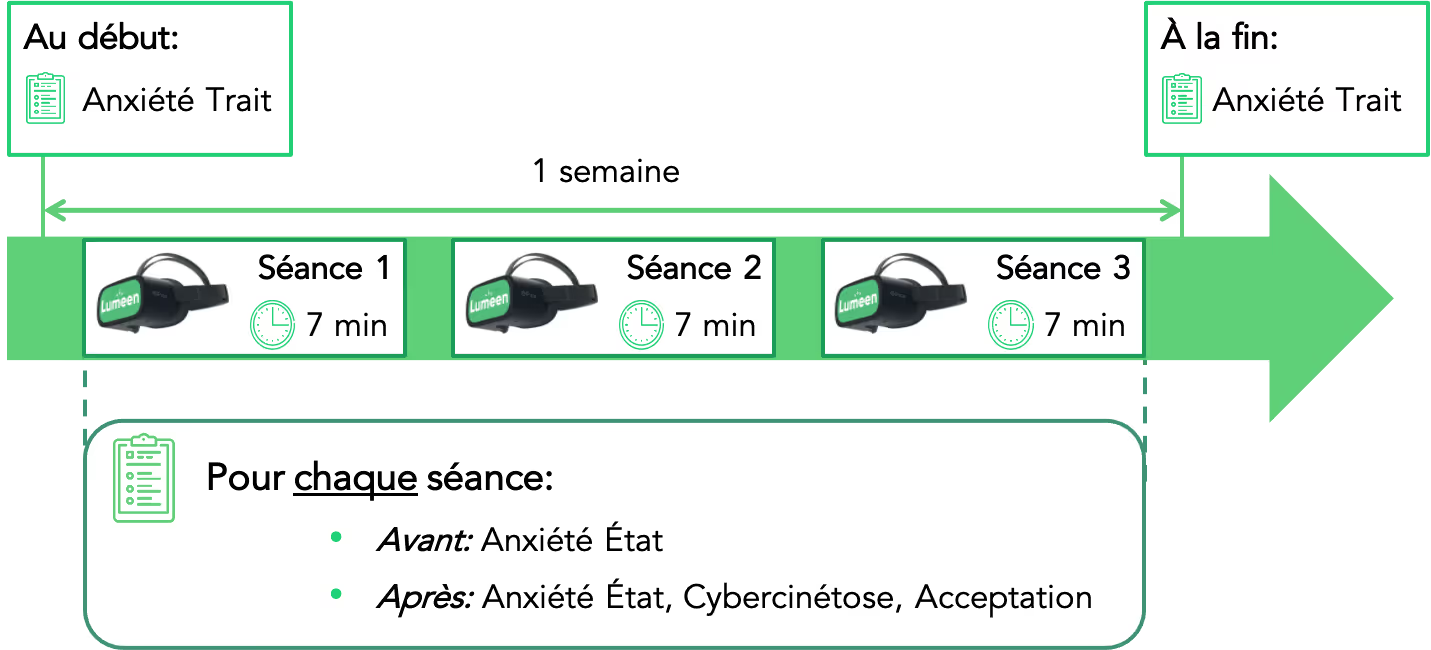
Figure 2. Schematic representation of protocol time, showing the order in which the various questionnaires were administered.
Thirty-sixcare homes residentscare homes to participate in the study. Among them, one participant dropped out after the first session due to a lack of motivation, and two others dropped out due to an intolerance to virtual reality manifested as cyberkinetosis.
Among the thirty-three participants (average age of 89) who completed the entire study:
- 61% experienced no symptoms of cyberkinetosis during the various immersive sessions,
- 21% experienced negligible or minimal, non-significant effects during at least one session,
- 18% experienced significant effectsduring at least one of the three sessions conducted. These results are shown in Figure 3.
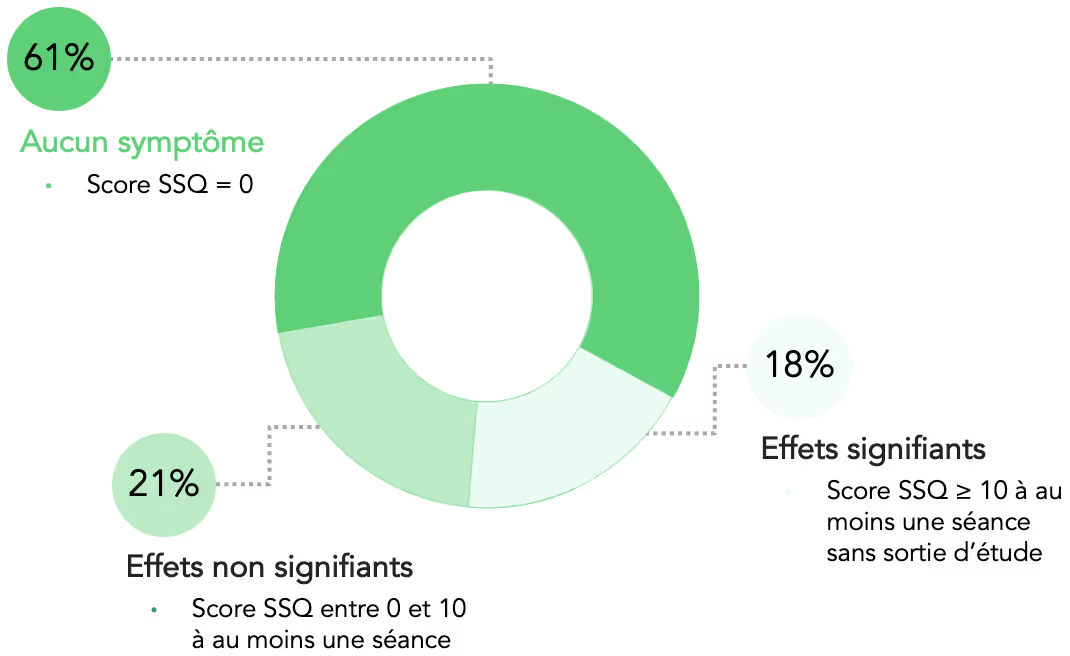
Figure 3. Participants' tolerance levels during virtual reality sessions.
anxiety traitanxiety did not vary significantly between before and after the experiment. In contrast, the mean stateanxiety scoresanxiety with the virtual reality experience virtual reality increase and even decreased significantly between the beginning and end of each session. This suggests that the Lumeen immersive experience is well tolerated.
When asked about their acceptance of the video headset, residents expressed high satisfaction with its use, giving it an average overall score of 29.9 out of 36 on the questionnaire, and reported a high intention to use it (an average of 4.31 out of 6).
The key takeaway
- The scenes developed by Lumeen and used in this study are tolerated by the majority of the elderly people in this study,
- This tolerance results in no or few symptoms of cyberkinetosis and reducedanxiety during immersive reality sessions,
- The residents surveyed in this study are satisfied with the system and report a high intention to use it.
To learn more…
Studies suggest that the likelihood of experiencing cyberkinetosis depends heavily on individual characteristics (susceptibility to motion sickness, gender, age, the presence of a neurological disorder, and/or the presence of a phobia)6. In particular, a previous study showed that susceptibility to cyberkinetosis decreases withage7. In the RAVI study, the analyses did not establish a link between the participants’ individual factors (age, cognitive ability,anxiety levelanxiety psychological well-being) and the onset of cyberkinetosis.
It should also be noted that the use of the SSQ to measure cybersickness has some limitations. As explained earlier, this questionnaire is not specific to cybersickness but was originally designed for military personnel using flight simulators. SSQ scores may differ in the general population and tend to be higher in virtual environments other thanflight simulators⁸,⁹. The emergence of new, validated, and standardized questionnaires specifically designed to assess cybersickness—such as the Cybersickness in VR Questionnaire (CSQ-VR), for example—could allow for a more accurate measurement of these symptoms in the future.
Acknowledgments
We would like to thank the authors of the article—Hajer Rmadi, Pauline Maillot, Romain Artico, Edouard Baudouin, Sylvain Hanneton, Gilles Dietrich, and Emmanuelle Duron—for using the virtual environments designed by Lumeen to conduct this research. This research is part of the VIRTUAGE project, which received financial support from the Île-de-France Region in the form of a “Paris RegionPhD2” doctoral grant. We would also like to thank our partners in the VIRTUAGE consortium: Gérond’if and Université Paris Cité.
.avif)
This initiative is supported by the Île-de-France Region.
*Partner centers:
care homes Léger care homes , 4 Avenue du Général Leclerc – 94600 Choisy-Le-Roi
care homes Zemgor, 33 Rue du Marray – 95240 Cormeilles-en-Parisis
care homes Roseraie care homes , 11 rue Paul Demange – 78290 Croissy-Sur-Seine
care homes Maison de la Chataigneraie, 35 Chemin Royal – 91310 Leuville-sur-Orge
Ferrari House – Order of Malta, 1 Place Ferrari – 92140 Clamart
care homes Hameau de Mesly care homes , 60 Avenue du Dr. Paul Casalis – 94000 Créteil
care homes maison des Clématites, 44 Rue de la Dauphine – 91100 Corbeil-Essonnes
care homes Maison du Grand Chêne care homes , 20 Rue de l’Abreuvoir – 77380 Combs-la-Ville
Bibliography
(1) LaViola, J. J. (2000). A discussion of cybersickness in virtual environments. ACM SIGCHI Bulletin, 32(1), 47–56. https://doi.org/10.1145/333329.333344
(2) Saredakis, D., Szpak, A., Birckhead, B., Keage, H. A. D., Rizzo, A., & Loetscher, T. (2020). Factors Associated With Virtual Reality Sickness in Head-Mounted Displays: A Systematic Review and Meta-Analysis. Frontiers in Human Neuroscience, 14, 96. https://doi.org/10.3389/fnhum.2020.00096
(3) McCauley, M.E. & Sharkey, T.J. (1992). Cybersickness: Perception of Self-Motion in Virtual Environments. Presence: Teleoperators and Virtual Environments, 1 (3): 311–318. https://doi.org/10.1162/pres.1992.1.3.311
(4) ANSES. (2020). Health effects associated with exposure to virtual reality augmented virtual reality technologies.
(5) Stanney, K. M., Kennedy, R. S., & Drexler, J. M. (1997). Cybersickness Is Not Simulator Sickness: Proceedings of the Human Factors and Ergonomics Society Annual Meeting. https://doi.org/10.1177/107118139704100292
(6) Howard, M. C., & Van Zandt, E. C. (2021). A meta-analysis of the virtual reality problem: Unequal effects of virtual reality sickness across individual differences. Virtual Reality, 25(4), 1221–1246. https://doi.org/10.1007/s10055-021-00524-3
(7) Paillard, A. C., Quarck, G., Paolino, F., Denise, P., Paolino, M., Golding, J. F., & Ghulyan-Bedikian, V. (2013). Susceptibility to motion sickness in healthy subjects and vestibular patients: Effects of gender, age, and trait anxiety. Journal of Vestibular Research, 23(4–5), 203–209. https://doi.org/10.3233/VES-130501
(8) Stanney, K. M., & Kennedy, R. S. (1997). The psychometrics of cybersickness. *Communication of the ACM*, 40, 66–68. https://doi.org/10.1145/257874.257889
(9) Kennedy, R. S., Drexler, J. M., Compton, D. E., Stanney, K. M., Lanham, D. S., & Harm, D. L. (2003). “Configural scoring of simulator sickness, cybersickness, and space adaptation syndrome: similarities and differences,” in Virtual and Adaptive Environments: Applications, Implications, and
* Human Performance Issues*, eds. L. J. Hettinger and M. W. Haas (Lawrence Erlbaum Associates Publishers), 247–278 . https://doi.org/10.1201/9781410608888.ch12
Want to test Lumeen for 30 days with no commitment? ?


.jpg)