
The Social and Therapeutic Benefits of virtual reality care homes
.avif)
More than 30 years of clinical research have demonstrated the social and therapeutic benefits of virtual reality. It is high time that care homes began to benefit care homes this new, non-pharmacological approach.
The Social Benefits of virtual reality care homes
You are 90 years old and live in care homes. Unfortunately, you have lost a great deal of mobility, and your physical condition no longer allows you to walk very far. What if, without leaving your chair, you could visit the pyramids of Egypt, go to a museum, go on a safari in Africa, or explore the wonders of nature And what if, on top of that, you could share these experiences with the other residents of your care homes create shared memories and exchange your feelings?
Immersive escapes improve well-being
elderly people experience virtual reality care homes an almost immediate sense ofGetaway well-being. Here are a few reactions captured on video that speak volumes.
A France 3 report from a care homes uses our virtual reality solution .
And that sensation being in a new place doesn't fade over time. Residents are eager for new destinations so they can continue to explore and discover. Here are their stories:
In addition, clinical trials have demonstrated the impact of virtual reality the well-being of elderly people care homes. Specifically, after a virtual reality session, residents experience greater positive emotional states, such as feelings of relaxation, joy, and adventure, among others (Appel et al., 2020).
Shared diving experiences foster social bonds
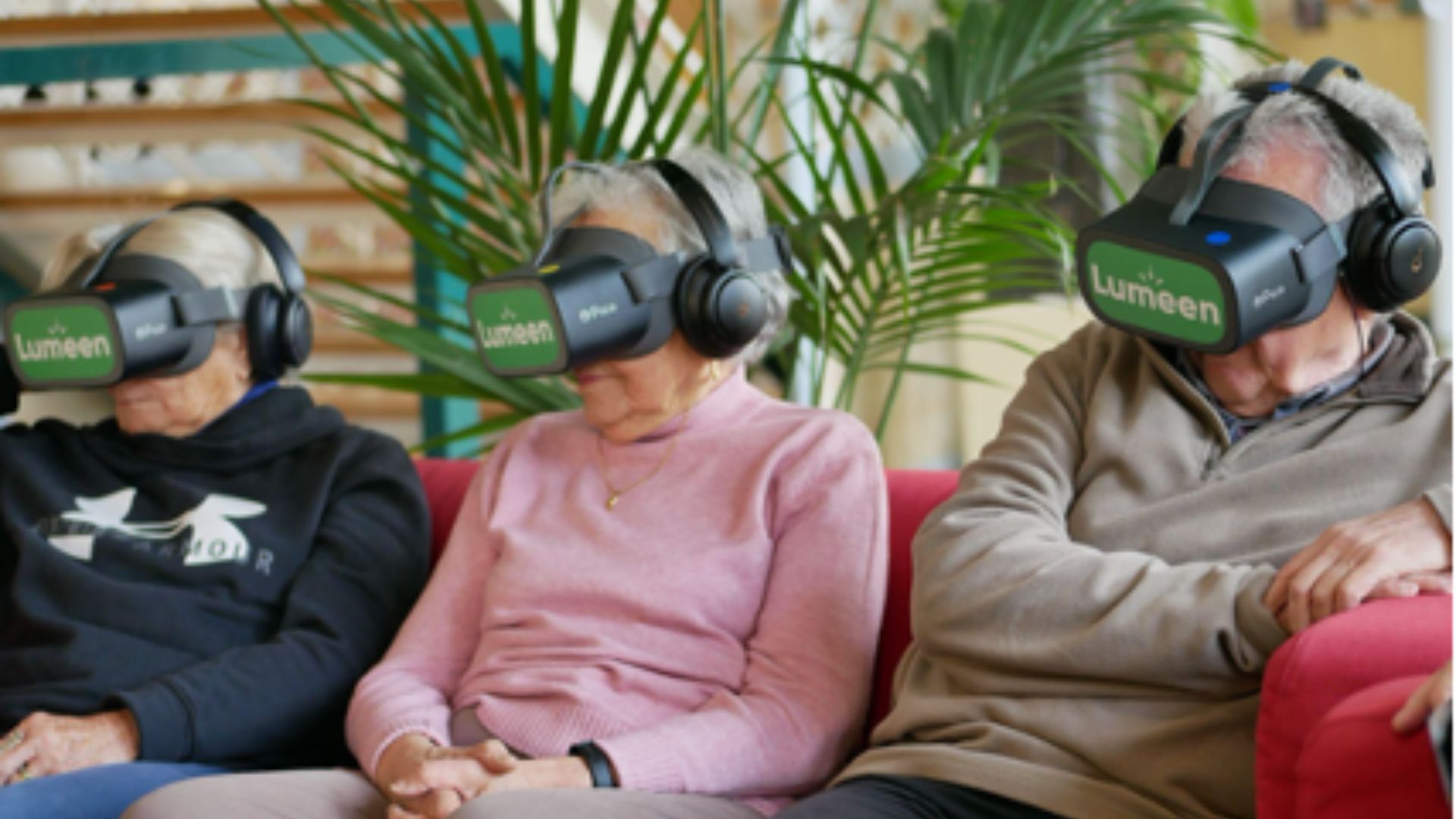
Social isolation and depression are major problems in care homes. To combat this issue and foster interaction and social connections, activity coordinators and caregivers facilities use various tools. virtual reality another tool to their arsenal, provided it is simple and well-suited to the setting. To that end, we’ve simplified its use so that staff can easily organize group workshops. Using a tablet app, it’s now possible to Headsets control and synchronize multiple Headsets to provide shared experiences.
Immersion then serves as a facilitator that allows facilitators to spark and nurture dialogue before, during, and after the videos. For example, before “teleporting” residents to the Red Sea, where dozens of dolphins swim freely, you can have them discuss dolphins by providing them with fun facts. At Lumeen, we enhance each of our experiences with educational content directly integrated into the tablet app. During the immersive experiences, you even get a visual preview of what the participants are seeing, along with prompts to guide them through the experience.
This content allows people to express themselves, reflect on their lives, and share memories. Activity coordinators and healthcare professionals also tell us that residents continue to talk about it after the sessions and during meals. It brings a little joy and vitality to their daily lives.
Making art and culture accessible to underserved audiences
People with addictions are often isolated and lose access to art and culture. virtual reality offers virtual reality a window to the world and allows them to visit museums and landmarks, and to attend shows and concerts.
At Lumeen, we aim to offer a wide range of cultural content. In particular, we partnered with the Atelier des Lumières in Paris to make the immersive digital exhibition on Gustav Klimt accessible to people who are otherwise unable to attend. This project was a huge success with elderly people really lit up their eyes.
Fostering Intergenerational Bonds
virtual reality also virtual reality strengthen family bonds. In many facilities, activity coordinators organize intergenerational activities and invite residents’ families to participate. However, it is not always easy to find activities that different generations can enjoy together. virtual reality the advantage of being entertaining for both young and old, and it allows families to continue sharing experiences together.
Whether for vacation or work, younger generations are traveling more and more. When residents’ loved ones go on long trips, virtual reality residents to immerse themselves in the countries and customs their families are visiting—and to tell them all about it when they return!
The Therapeutic Benefits of virtual reality care homes
As the population ages, providing care for the physiological and psychological disorders affecting elderly people a major public health issue. According to the Médéric Alzheimer Foundation, 57% of care homes residents care homes from cognitive disorders to severe cognitive disorders . Neurodegenerative conditions gradually rob individuals of their independence and social life—both of which are essential to well-being and health. Patients with dementia often exhibit signs of confusion, disorientation, irritability, or aggression as their ability to understand the world diminishes.
cognitive disorders psychological and behavioral problems in older adults. These are relatively common and are part of the daily routine for care homes staff. Examples include euphoria,anxiety, agitation, aggression, disinhibition, apathy, irritability, depression, sleep disorders, etc.
In care homes, healthcare teams support people at various stages of these diseases. Therefore, virtual reality solutions virtual reality for them must be flexible enough to integrate into their care practices and adapt to patients and their conditions.
Here is an overview of the most significant therapeutic benefits that virtual reality can offer virtual reality care homes
Relieveanxiety pain
virtual reality divert patients' attention away from their anxiety pain. One of the most widely studied virtual environments is “Snow-World.” In 1996, Hunter Hoffman, PhD, and his colleagues at the University of Washington developed an immersive experience that creates the illusion of flying through a frozen canyon. As they explore this cool, serene world, patients can throw snowballs at penguins, mammoths, and snowmen.
SnowWorld was designed for people suffering from pain . In particular, this immersive game is used to distract patients with severe burns during painful procedures. And the results speak for themselves. The 11 patients included in a study reported a 35% to 50% reduction in pain the SnowWorld experience (Hoffman et al., 2011).
Since Snow World, virtual reality evolved significantly, and numerous studies have highlighted its effects onanxiety pain. Jones et al. (2016) show that among the 30 participants with chronic pain in their study, 100% experienced a relative reduction in pain a virtual reality experience, with 33% reporting complete pain relief. The analgesic effects of virtual reality beyond the session, as an average 33% reduction in pain perception continues afterward.
For these reasons, virtual reality now used in hundreds of hospitals around the world. The most popular solutions combine calm environments with music therapy and guided relaxation techniques based on the principles of medical hypnosis to further soothe patients. As a result, these approaches allow for a reduction in the use of pain medication. virtual reality therefore now considered a non-pharmacological alternative in certain cases.
Immersive journeys that bring back memories
The places we’ve known and loved are filled with memories. Imagine an older person who could return to visit the neighborhood of their childhood or the place where they were proposed to? virtual reality stimulate emotional memory and bring buried memories back to life. It is particularly valuable in reminiscence therapy sessions, especially since the sensation provided by the 360-degree view seems to enhance the reminiscence. The study by Benoit et al. (2015) shows that virtual reality significantly virtual reality autobiographical memory.
As life draws to a close, returning to the places one has loved brings a sense of peace and happiness. It is in these memories that residents can often find a comforting connection to themselves.
Boost Cognitive Function
Through interactive Games , virtual reality a fun way to stimulate specific cognitive functions. Note that this does not involve creating virtual versions of activities that can be performed with everyday objects, such as a deck of cards or a ball. It is far more relevant to focus on the new activities that virtual reality can offer. In three dimensions, we can create space and move within it. This opens up a world of possibilities for orientation and spatial memory exercises that are difficult to carry out in a real-world environment—particularly given the risk of people falling. On another note, the ability to view environments in 360 degrees makes it possible to design more sophisticated visual-spatial orientation activities.
These Games are flexible and Games be adapted to patients’ levels of dependency, integrating fully into the practice of neuropsychologists, psychomotor therapists, occupational therapists, and other caregivers. Several studies involving a total of 564 individuals with cognitive disorders , stroke, or Alzheimer’s disease have shown that the use of VR improves their cognitive abilities, such as memory and visual attention (Moreno et al., 2019).
Finally, it should be noted that the technology’s fun and eco-friendly aspects help increase patient motivation and engagement. A study involving 66 elderly people that they were more motivated following a VR experience. In fact, 76% of them wanted to repeat the experience (Appel et al., 2020).
Combating Depression and Apathy
Depression and apathy are, unfortunately, very common in care homes. According to the Directorate for Research, Studies, Evaluation, and Statistics (DREES) (2020), between 20% and 33% ofcare homes residentscare homes from depression. Apathy, which manifests as a loss of motivation, social withdrawal, a feeling of low energy, and emotional blunting, is one of the most common behavioral disorders associated with Alzheimer’s disease. As noted by the Alzheimer’s Foundation, 60% of elderly people this condition are affected by it. The study by Geraets et al. (2019) shows that the use of virtual reality generalized anxiety and associated depressive symptoms.
Through experiences involving reminiscence, discovery, relaxation Games, virtual reality elderly people with powerful emotions that rekindle their passions and motivation. This even helps reestablish communication with some residents. The study by Saredakis et al. (2020) shows that virtual reality in reminiscence therapy reminiscence a positive effect on cognition and apathy in elderly people. Thus, immersive experiences have a positive impact on people who are depressed or apathetic.
Risks to Consider
Of course, it is important to identify the risks associated with using virtual reality patients. For example, how might this technology affect someone experiencing delusions and hallucinations? Could it exacerbate their condition? We don’t have all the answers yet, but we have a responsibility to conduct clinical trials that will help establish clear and safe therapeutic indications and protocols.
Benefits for Healthcare Teams and Facilities
We were surprised the first time we learned that caregivers our tool to offerGetaway sessionsGetaway staff at their care homes. But looking back, it makes perfect sense! Caring for elderly people is a difficult and demanding job, which results in high absenteeism rates and frequent staff turnover. By offering staff momentsGetaway relaxation, virtual reality improve workplace well-being in care homes.
In addition, virtual reality make careers more appealing in an industry that is struggling to recruit. Indeed, cutting-edge solutions project an image of innovation that attracts talent.
Conclusion
virtual reality care homes numerous benefits virtual reality care homes . It helps improve residents’ well-being and care, relationships with families, the facilities’ reputation, working conditions, and the appeal of careers in elder care.
We hope that virtual reality its place in care homes help improve the quality of life for elderly people and maintain their mental health for as long as possible.
References
Appel L, Appel E, Bogler O, Wiseman M, Cohen L, Ein N, Abrams HB, and Campos JL (2020) Older Adults With Cognitive and/or Physical Impairments Can Benefit From Immersive Virtual Reality Experiences: A Feasibility Study. Front. Med. 6:329. doi: 10.3389/fmed.2019.00329
Benoit, M., Guerchouche, R., Petit, P. D., Chapoulie, E., Manera, V., Chaurasia, G., Drettakis, G., & Robert, P. (2015). Is it possible to use highly realistic virtual reality in the elderly? A feasibility study with image-based rendering. Neuropsychiatric Disease and Treatment, 11, 557–563. https://doi.org/10.2147/NDT.S73179
Saredakis, D., Keage, H. A., Corlis, M., & Loetscher, T. (2020). Using Virtual Reality to Improve Apathy in Residential Aged Care: A Mixed-Methods Study. Journal of Medical Internet Research, 22(6), e17632. https://doi.org/10.2196/17632
Shirine Abdoul-Carime (DREES), 2020, “One-third of elderly people in care facilities are in a deteriorated psychological state,” Études et Résultats, No. 1141, DREES, January.
https://www.fondation-alzheimer.org/lapathie-le-symptome-oublie-de-la-maladie-dalzheimer/
https://www.fondation-mederic-alzheimer.org/les-chiffres-cles
Hoffman, H. G., Chambers, G. T., Meyer, W. J., 3rd, Arceneaux, L. L., Russell, W. J., Seibel, E. J., Richards, T. L., Sharar, S. R., & Patterson, D. R. (2011). Virtual reality as an adjunctive non-pharmacologic analgesic for acute burn pain during medical procedures. Annals of Behavioral Medicine: A Publication of the Society of Behavioral Medicine, 41(2), 183–191. https://academic.oup.com/abm/article-abstract/41/2/183/4569537
Moreno, A., Wall, K.J., Thangavelu, K., Craven, L., Ward, E., and Dissanayaka, N.N. (2019). A systematic review of the use of virtual reality and its effects on cognition in individuals with neurocognitive disorders. Alzheimer’s & Dementia: Translational Research & Clinical Interventions 5, 834–850. doi: https://alz-journals.onlinelibrary.wiley.com/doi/full/10.1016/j.trci.2019.09.016
Report by the French Society of Geriatrics and Gerontology (SFGG) on depression in care homes.
Want to test Lumeen for 30 days with no commitment? ?


.jpg)