
virtual reality Patients During Dialysis Sessions: Findings from an Evaluation Conducted by Santélys
.avif)
Dialysis is a crucial treatment for people with chronic kidney disease, but it can be difficult to cope with, both physically and emotionally. Fortunately, there are tools available to help ease patients’ discomfort. virtual reality provide a distraction during dialysis sessions. In this article, we’ll explore the various benefits of virtual reality dialysis treatment, based on feedback from a trial conducted by Santélys on the use of Headsets in 19 of its dialysis units.
Santélys is a nonprofit organization recognized as serving the public interest that specializes in Homecare health care Homecare Training, operating in the Hauts-de-France and Bourgogne-Franche-Comté regions. More specifically, it has expertise in dialysis treatment: patients with chronic kidney disease are cared for in assisted and medical dialysis units or through Homecare. Since its founding, Santélys has placed improving patients’ quality of life and maintaining their social well-being at the heart of its approach. To this end, the association is constantly seeking new non-pharmacological methods and techniques to draw upon and is committed to an evaluation process to measure their impact on care pathways. It was from this ambition that an active collaboration with Lumeen began in April 2021.
As a result, virtual reality Headsets have been incorporated into the range of “wellness care” tools offered during dialysis sessions. To evaluate the benefits for patients, Santélys is conducting a pilot program at several of its facilities: in Dole and Dijon, for example, the UDM (medical dialysis unit) and UAD (self-dialysis unit) departments are participating. Patients complete questionnaires before, during, and after treatment to self-assess their “well-being score” during the session and track its progression over the study period:
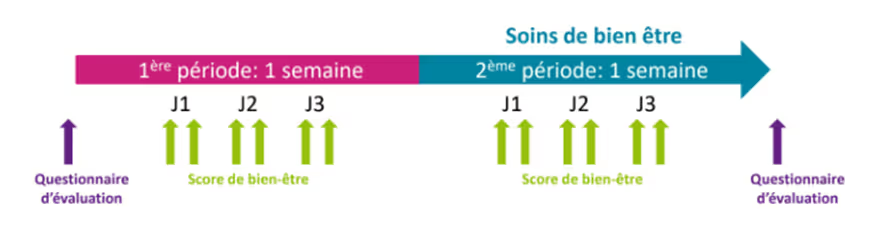
The trial conducted by Santélys is taking place in two phases:
- Phase I, conducted in four dialysis units, during which 71 patients will test the headset at least once: a total virtual reality 172 virtual reality sessions will virtual reality offered;
- A Phase II trial, this time conducted across 19 dialysis units and involving 201 patients: a total of 318 sessions will be organized and evaluated by the patients.
From “ a breath of fresh air” to “ Getaway momentGetaway or even sensation well-being,” the feedback received is generally positive in many respects, from both patients and caregivers. And the benefits observed are twofold!
Distracting dialysis patients during anxiety-inducing or painful phases
Dialysis sessions are a burdensome form of treatment that all too often cause stress and discomfort. In 2018, a survey conducted by Santélys among dialysis patients also found that one in five patients experienced pain during dialysis sessions. Lasting an average of 3 to 4 hours, the treatment also requires patients to undergo several sessions per week.
That is why virtual reality experiences have been implemented in dialysis units as one of the “well-being” tools offered to patients during their sessions. Most often (74% of the time), the Headsets used during the first two hours of the session. Laura, a nurse, explains that they are generally offered to patients after their morning or afternoon snack. The idea is to promote the patient’s well-being by helping them take their mind off the medical care they are receiving.
A new, gentler, and more soothing approach
Headsets primarily used with patients who express significant anxiety, whether regarding the procedure itself or the effects of the treatment. The goals are clear: to help patients relaxation start of their care journey, to alleviate physical and psychological pain, and to facilitate a gentler approach.
First, caregivers to introduce the headset and explain how to use it to the patient before treatment begins. The experience can then be offered to patients who express an interest in it, right during the procedure. This approach is particularly helpful for anxious patients or new patients.
" I'm very happy to have discovered this as a way to escape the dialysis setting and the medical environment. "
At the end of the trial, 61.8% of patients surveyed in Phase I reported that using the Headsets had an effect on how they felt during the session. At the end of Phase II, 57% of patients surveyed reported a predominantly beneficial effect onanxiety. Among the terms most frequently used by patients to describe their experience were “ relaxation ,” “calm,” “a sensation relaxation,” and “muscle relaxation.”
A solution a Better Understanding of Aspirations
Furthermore, Laura praises the tool’s benefits “for difficult needle insertions.” She cites the example of a patient requiring daily hemodialysis who had a severe fear of needles. This fear manifested as severe agitation—both emotional and physical—and as a result, the patient was unable to perform the procedure on his own or even watch as caregivers performed it. Moreover, it made it extremely difficult for caregivers to perform the procedure.
Initially, the headset was offered to him to help distract him from the procedure and allow him to relax. But very quickly, the results far exceeded these expectations: it was a real “lightbulb moment”—using the virtual reality headset quickly allowed virtual reality to “view the procedure differently,” in Laura’s words, and to come to terms with this medical procedure in just a few sessions. The patient has now been receiving dialysis through Homecare almost a year!
An indirect but significant consequence: the virtual reality experience virtual reality also proven beneficial for many caregivers. Diverting the patient’s attention away from the medical procedure being performed has, in fact, sometimes served as a facilitating factor: since the patient is less agitated and is not focused on the procedure itself or the anxiety it may cause, the quality of care is improved (by relieving the caregiver of some pressure, the procedure can be performed more quickly and even more precisely).
Escaping the Healthcare Journey Through virtual reality
A dialysis session lasts several hours and restricts patients’ movements; it can quickly become long and tedious. Without the ability to focus their attention elsewhere, there is a high risk that patients will fixate on negative perceptions and emotions. By offering immersive experiences, virtual reality easily serve as a distraction—an opportunity for patients to step outside the context of their treatment and escape from it, if only for a moment.
" It's amazing to have this tool during dialysis—it really makes me feel good and helps me relax. I don't even feel like I'm on dialysis anymore when I have the headset on. Thank you! "
Offer entertaining and positive experiences
In Santélys’ dialysis units, virtual reality Headsets virtual reality added to the other tools already available to patients, such as exercise bikes and socio-aesthetic care. The goal is clear: to provide distraction a space for distraction through “ fun ” activities and to refocus their attention on a positive and entertaining experience, thereby helping them sensation .
virtual reality experiences virtual reality key virtual reality in this mission. Headsets users to discover new settings, new atmospheres, and new destinations. In fact, the Getaway module, offered by Lumeen, is the most frequently requested: it offers a plunge into a new world of sound and visuals and often allows patients to open a new window onto the world and “discover something else,” whether it’s a “bubble of tranquility , ” the contemplation of “beautiful images,” or a “spectacular” experience!
The Lumeen catalog offers a selection of more than 100 pieces of content and is constantly evolving to meet the preferences and needs expressed by Headsets users; new modules and experiences are added regularly.
Convincing results observed by Santélys, for the well-being of dialysis patients
In response to the general question, “Did the relaxation method relaxation help you feel better? ”, 79.2% of the patients surveyed in Phase I answered yes.
Following the completion of Phase II of the Santélys survey:
· 87% of patients said they were satisfied or very satisfied with the session;
· 84% reported a “significant impact on the time spent in sessions”;
· 84% of patients reported a “significant improvement in their sensation well-being after the session”;
· 78% reported a “significant impact on their experience of the session.”
The primary objectives virtual reality Santélys virtual reality use Headsets virtual reality Headsets were to foster a patient-centered approach and to improve the well-being and quality of life of dialysis patients through the use of non-pharmacological techniques. The study, conducted with the support of caregivers patients, showed that the initial results were compelling and promising.
We would like to thank everyone who has been involved over the past few months for their initiative and commitment to carrying out this study. Lumeen, of course, intends to continue working alongside its partners as we move forward from this adventure, which has been rich in learning experiences, social connections, and opportunities to escape the everyday.
Want to test Lumeen for 30 days with no commitment? ?


.jpg)