
At HCL, virtual reality its place in Palliative care.
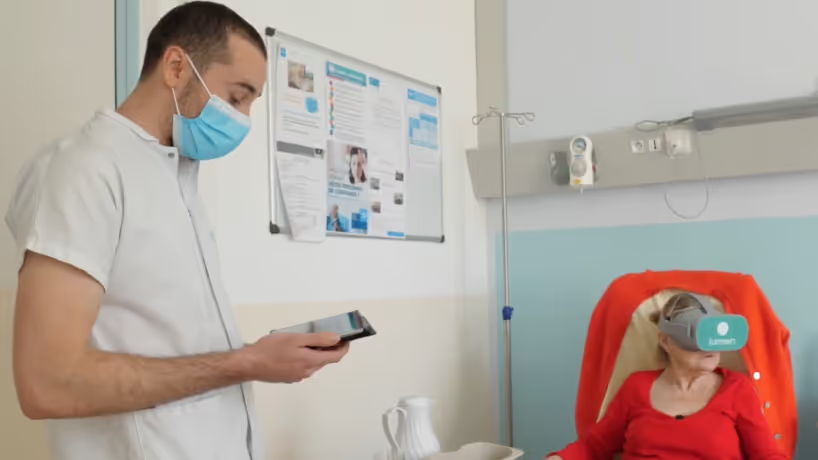
Since 2020, the Palliative care Department Palliative care Lyon Sud Hospital, part of the Hospices Civils de Lyon (HCL), has been using virtual reality Headsets , and the feedback has been excellent. The department’s goal is to relieve physical pain and address psychological, social, and spiritual suffering. This is where Lumeen really comes into its own. Dorothé Decrept, health care manager :“The results are immediate! Patients tell us right away whether they enjoyed it or not, and for 95% of them, it’s a truly satisfying experience.” But what are the therapeutic and social benefits that virtual reality brings virtual reality Palliative care
1) The Holistic Approach to Palliative care
Palliative care active care provided as part of a holistic approach to individuals with a serious, progressive, or terminal illness. The goal of Palliative care to relieve physical pain and other symptoms, while also addressing psychological, social, and spiritual suffering. Far from the image of a hospice that many may have, palliative care often serves as a transitional care setting for patients before they return home. The palliative care approach is not limited to end-of-life care. On the contrary, it is all the more effective when implemented as soon as a serious, incurable illness is diagnosed or when a severe complication arises. “In our department, we regularly see patients again during their various hospital stays. There’s one patient we’ve been caring for for nearly 10 years!” notes Prof. Elise Perceau-Chambard, head of the department. Palliative care units Palliative care centers of expertise and resources in many situations, particularly for intractable symptoms—and first and foremost, pain. It’s about knowing how to find the treatments that will bring relief to patients, and to do that, we must act quickly and effectively, because our patients cannot wait.”
2) The Therapeutic Benefits of virtual reality Palliative care
In recent years, virtual reality used in Palliative care the world, and, as several clinical studies have shown, it offers a number of therapeutic benefits. Of the 18 studies published between 2007 and 2018, 12 (including 9 randomized controlled trials of recognized methodological quality) showed a statistically significant reduction in pain the use of virtual reality care—either in combination with an analgesic and compared to the analgesic alone, or used as the sole pain management strategy pain compared to other forms distraction Games or television (Meta-analysis by Smith et al., 2020). Furthermore, in 2019, researchers at Osaka University in Japan conducted a study of 20 elderly patients with terminal cancer in Palliative care demonstrated that immersion in virtual reality Google Earth VR reduced pain 51% andanxiety 69%*.
Tom Muselet, a nursing assistant in the Palliative care Unit Palliative care Lyon-Sud Hospital, explains:“We use Lumeen extensively during painful procedures that painful procedures anxiety-inducing for the patient, and we really see a rapid effect. Often, patients don’t even remember the procedure.” In addition, virtual reality serve as a non-pharmacological therapy or as a complement to anxiolytic or analgesic treatments to reduce the use of medications that sometimes have unwanted side effects. According to Audrey Ringot, project manager at the Oncology Coordination Unit at Lyon-Sud Hospital:“Using the headset in combination with opioids is more beneficial than opioids alone. It’s very effective during painful procedures
3) The Social Benefits of virtual reality Palliative care
virtual reality patients to escape the reality of their illness and their hospital room. It offers them moments of daydreaming and connection that have a beneficial impact on sociocultural factors (managing daily life, social and professional life on hold, self-image) and spiritual factors (the future) related to illness and end-of-life care. For Rémi, a patient who uses virtual reality Headsets , it’s a breath of fresh air:“No matter which film you choose, it’s the power to escape. You push back the walls of the room you’re in.” Getaway module provides extraordinary experiences and promotes well-being. These are fully immersive videos centered on nature, culture, and travel: you can swim with dolphins, admire the Northern Lights in Alaska, or visit the Grand Canyon. “It’s a timeless escape,” says Mr. D, 58;“For a moment, I forgot I was in Palliative care.”
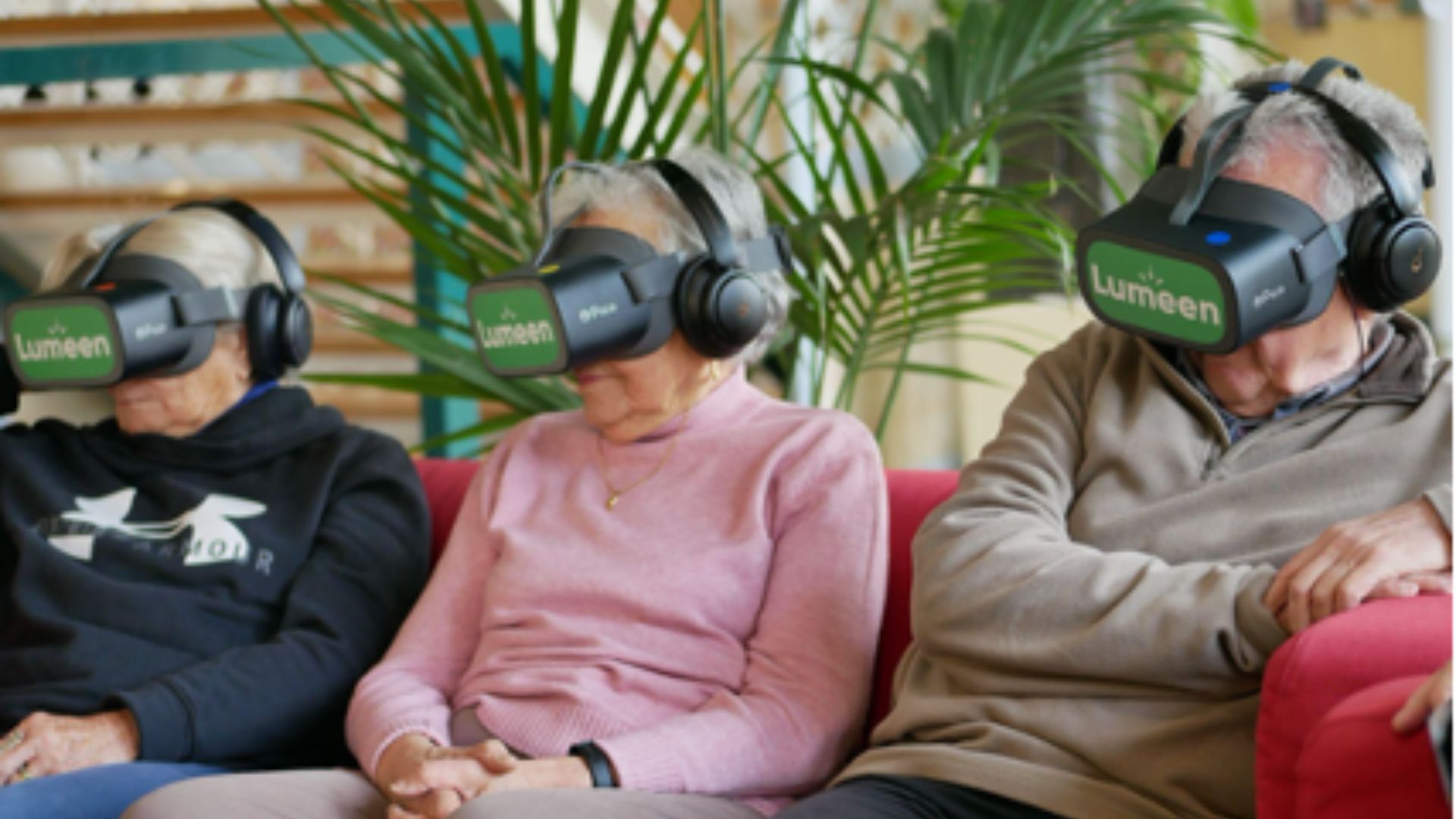
In addition, virtual reality fond memories and strengthens bonds with loved ones. Palliative care patients often Palliative care to revisit places they’ve loved, such as their vacation spots or wedding venues. “It reminds me of the trips I used to take with my husband,” says Jeannine Frot after her virtual trip to Japan. reminiscence program is designed to meet this need by transporting these individuals anywhere in the world using Google Maps. “We also use Lumeen to allow our patients to share travel memories, for example, or experiences with their loved ones during visits,” explains Dorothée Decrept, the department’s manager. These precious memories are soothing and comforting. As mentioned earlier, the Japanese study from Osaka University also highlighted a significant improvement in well-being (51%) following a virtual reality session virtual reality Google Earth VR.
4) Conclusion
In Palliative care, virtual reality undeniably virtual reality the care journey. Easy to use, it can be set up in less than a minute and offers real benefits to patients. Furthermore, it helps bring vitality to patients’ lives and challenges common misconceptions: the goal of Palliative care to help patients die, but rather to help them live as comfortably and meaningfully as possible.
We are delighted with the feedback from the Palliative care team Palliative care Lyon Sud Hospital; aclinical study proposalclinical study currently being drafted. Stay tuned for updates.
Resources:
"Niki, Kazuyuki, Yoshiaki Okamoto, Isseki Maeda, Ichiro Mori, Ryouhei Ishii, Yoshinobu Matsuda, Tatsuya Takagi, and Etsuko Uejima. "A novel palliative care approach using virtual reality to improve various symptoms in patients with terminal cancer: a preliminary prospective, multicenter study." Journal of Palliative Medicine 22, no. 6 (2019): 702–707."
Niki, Kazuyuki, Megumi Yahara, Michiya Inagaki, Nana Takahashi, Akira Watanabe, Takeshi Okuda, Mikiko Ueda, Daisuke Iwai, Kosuke Sato, and Toshinori Ito. "Immersive virtual reality reminiscence reduces anxiety in the oldest-old without causing serious side effects: a single-center, pilot, randomized crossover study." Frontiers in Human Neuroscience (2021): 595.
Smith, V., Warty, R. R., Sursas, J. A., Payne, O., Nair, A., Krishnan, S., ... & Vollenhoven, B. (2020). The effectiveness of virtual reality in managing acute pain and anxiety in hospitalized patients: a systematic review. Journal of Medical Internet Research, 22(11), e17980.
https://www.parlons-fin-de-vie.fr/la-fin-de-vie-en-pratique/les-soins-palliatifs/
https://www.sfap.org/rubrique/definition-et-organisation-des-soins-palliatifs-en-france
https://www.chu-lyon.fr/soins-palliatifs-une-demarche-qui-ne-se-limite-pas-la-fin-de-vie
Want to test Lumeen for 30 days with no commitment? ?


.jpg)